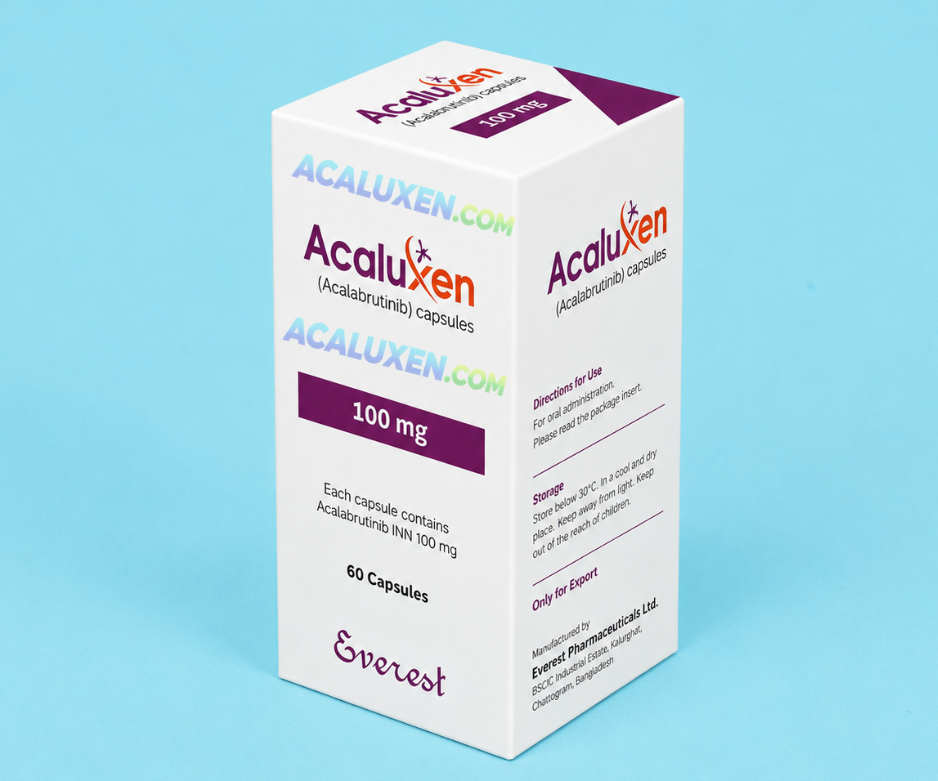
Acaluxen 100 mg (Acalabrutinib)
Disclaimer: Before purchasing any medicine, always verify whether there is a valid drug license.
Acaluxen 100 mg is identified for this website as a product containing acalabrutinib 100 mg, an oral Bruton tyrosine kinase (BTK) inhibitor used in selected adult B-cell malignancies. The specific manufacturer, marketing authorization holder, manufacturing site, packaging, country of authorization and regulatory status of the Acaluxen-branded product should be verified against its actual packaging and applicable regulatory documentation before publication.
Acalabrutinib is the active ingredient in the established reference medicine CALQUENCE. Acalabrutinib was developed as ACP-196 by Acerta Pharma, which became part of AstraZeneca’s oncology development organization after AstraZeneca acquired a majority equity stake in Acerta Pharma in 2016. AstraZeneca subsequently developed and commercialized CALQUENCE. The U.S. Food and Drug Administration granted the first U.S. approval for acalabrutinib on October 31, 2017, initially for adults with mantle cell lymphoma who had received at least one prior therapy.
The current U.S. CALQUENCE labeling identifies 100 mg as the marketed capsule and tablet strength. The February 2026 label states that the capsule product is manufactured for AstraZeneca Pharmaceuticals LP by AstraZeneca AB, Sweden, with the product identified as a product of Switzerland.
Everest Pharmaceuticals Ltd. About the Manufacturer
Everest Pharmaceuticals Ltd. is a pharmaceutical manufacturer based in Bangladesh. The company is involved in the development, production, and marketing of pharmaceutical products, including medicines used in specialized therapeutic areas.
Everest Pharmaceuticals focuses on manufacturing quality medicines for the healthcare market and offers a range of products, including treatments used in oncology and other medical fields. Its product portfolio includes various generic medicines formulated for patients and healthcare providers.
Company Name: Everest Pharmaceuticals Ltd.
Industry: Pharmaceutical Manufacturing
Country: Bangladesh
Business Activities: Manufacturing, marketing, and distribution of pharmaceutical products
Product Areas: Includes specialized and general pharmaceutical medicines
Quality Focus: Product manufacturing and quality-control processes are intended to support medicine quality, safety, and regulatory compliance.
For product-specific information, it is important to check the official packaging, product insert, batch details, and manufacturer information, as formulations and regulatory status may vary by product and market.
Head Office: Everest Pharmaceuticals Ltd. is located at Rahman’s Regnum Centre (10th & 11th floor), 191/1 Tejgaon Commercial Area, Dhaka-1208, Bangladesh.
Manufacturing Plant: Everest Pharmaceuticals Limited B-33, 45 & 46, BSCIC, Kanchpur, Narayanganj–1430, Bangladesh.
| Topic | Information |
|---|---|
| Product name | Acaluxen |
| Active ingredient | Acalabrutinib |
| Stated strength | 100 mg |
| Therapeutic category | Antineoplastic agent |
| Drug class | Bruton tyrosine kinase (BTK) inhibitor |
| Pharmacologic type | Selective small-molecule BTK inhibitor |
| Route | Oral, subject to Acaluxen-specific product documentation |
| Reference product | CALQUENCE |
| Original development code | ACP-196 |
| Original developer | Acerta Pharma |
| Current reference-product developer/commercial organization | AstraZeneca |
| Initial U.S. approval of acalabrutinib | October 31, 2017 |
| Acaluxen manufacturer | Everest Pharmaceuticals Ltd. |
| Acaluxen marketing authorization holder | Everest Pharmaceuticals Ltd. |
| Acaluxen regulatory status | Prescription-only medication (Rx) |
Acaluxen should not be represented as CALQUENCE merely because both products contain acalabrutinib. Product identity, formulation, manufacturer, authorization pathway and packaging must be established separately.
What Is Acalabrutinib?
Acalabrutinib is an oral targeted anticancer medicine belonging to the class of Bruton tyrosine kinase inhibitors.
BTK is an important signaling protein in the B-cell receptor and cytokine-receptor pathways. These pathways contribute to B-cell proliferation, trafficking, chemotaxis and adhesion. Acalabrutinib and its active metabolite, ACP-5862, form a covalent bond with a cysteine residue in the BTK active site, thereby inhibiting BTK enzymatic activity.
By interfering with BTK signaling, acalabrutinib can inhibit signaling processes that support the growth and survival of malignant B cells.
How Does Acalabrutinib Work?
Acalabrutinib is designed to selectively inhibit Bruton tyrosine kinase (BTK).
BTK is located downstream of the B-cell receptor and participates in signaling pathways that help regulate B-cell activation and survival. In malignant B-cell disorders, continued activity of these pathways can contribute to disease progression.
Acalabrutinib binds covalently to BTK and inhibits its enzymatic activity. The resulting disruption of B-cell receptor signaling can interfere with malignant B-cell proliferation and other cellular processes. Nonclinical studies have demonstrated inhibition of downstream signaling proteins and malignant B-cell proliferation.
At the recommended 100 mg dose administered approximately every 12 hours, the FDA label reports median steady-state BTK occupancy of at least 95% in peripheral blood over the dosing interval.
Simple explanation
In simple terms, acalabrutinib blocks an important signaling protein that certain abnormal B cells depend on. This targeted mechanism is different from conventional cytotoxic chemotherapy because it is directed at a specific molecular pathway involved in B-cell biology.
What Is Acaluxen 100 mg Used For?
Because Acaluxen-specific authorization information has not been verified, approved uses should be determined from the applicable product documentation.
The current U.S. CALQUENCE labeling covers adult patients with:
1. Previously untreated mantle cell lymphoma
CALQUENCE, in combination with bendamustine and rituximab, is indicated for adults with previously untreated mantle cell lymphoma (MCL) who are not eligible for autologous hematopoietic stem-cell transplantation.
2. Previously treated mantle cell lymphoma
CALQUENCE is indicated for adults with MCL who have received at least one prior therapy.
3. Chronic lymphocytic leukemia
CALQUENCE is indicated for adult patients with chronic lymphocytic leukemia (CLL).
4. Small lymphocytic lymphoma
CALQUENCE is also indicated for adults with small lymphocytic lymphoma (SLL).
Regulatory indications can differ between countries. Therefore, information about CALQUENCE or acalabrutinib in one jurisdiction should not automatically be presented as an approved indication for Acaluxen in another jurisdiction.
Acaluxen 100 mg Dosage and Administration
The exact dosage of Acaluxen should be based on the prescription and the official product information applicable to the specific product.
For the current U.S. CALQUENCE product, the recommended dose is:
100 mg orally approximately every 12 hours.
The medicine may be taken with or without food.
Patients should swallow the dosage form whole with water and should not independently change the prescribed dose.
Current U.S. CALQUENCE dosing overview
| Treatment setting | Labeled acalabrutinib regimen |
|---|---|
| MCL, previously treated | 100 mg approximately every 12 hours |
| MCL, previously untreated, with bendamustine + rituximab | 100 mg approximately every 12 hours |
| CLL/SLL monotherapy | 100 mg approximately every 12 hours |
| Previously untreated CLL/SLL with obinutuzumab | 100 mg approximately every 12 hours |
| Previously untreated CLL/SLL with venetoclax | 100 mg approximately every 12 hours, with regimen-specific duration |
The current U.S. label also contains detailed instructions for dose modification when acalabrutinib is used with certain CYP3A inhibitors or inducers and for management of adverse reactions.
Acaluxen-specific dosing should not be assumed solely from the CALQUENCE label unless the Acaluxen product has been established as therapeutically equivalent and authorized under the applicable regulatory framework.
How to Take Acaluxen
If the Acaluxen product documentation confirms the same oral formulation and dosing instructions applicable to acalabrutinib:
-
Take the medicine exactly as prescribed.
-
Take it approximately every 12 hours when prescribed twice daily.
-
It may be taken with or without food under current U.S. CALQUENCE labeling.
-
Swallow the dosage form whole with water.
-
Do not chew, crush, dissolve or cut tablets.
-
Do not take additional doses to compensate for a missed dose.
Under the current U.S. CALQUENCE label, if a dose is missed by more than 3 hours, the missed dose should be skipped and the next dose taken at its regular time. Extra capsules or tablets should not be taken to make up for the missed dose.
Available Strength
The Acaluxen product identified on this website is:
Acaluxen 100 mg
| Product characteristic | Information |
|---|---|
| Active ingredient | Acalabrutinib |
| Strength | 100 mg |
| Route | Oral, subject to product documentation |
| Therapeutic class | Antineoplastic |
| Drug class | BTK inhibitor |
| Reference brand | CALQUENCE |
The current U.S. CALQUENCE label identifies 100 mg as the tablet strength and also identifies 100 mg capsules. The capsule is described as a hard gelatin capsule containing 100 mg acalabrutinib.
The Acaluxen dosage form and formulation should be verified from its actual packaging and product documentation.
Acalabrutinib Reference Product
The established reference brand for acalabrutinib is CALQUENCE.
Acalabrutinib was developed as ACP-196 by Acerta Pharma. In December 2015, AstraZeneca announced an agreement to acquire a majority equity stake in Acerta Pharma, and the transaction was completed in February 2016. AstraZeneca acquired 55% of Acerta’s issued share capital at that time.
The FDA’s orphan-drug records identify Acerta Pharma as the sponsor for acalabrutinib and record CALQUENCE’s first U.S. marketing approval on October 31, 2017.
AstraZeneca subsequently became responsible for the development and commercialization of CALQUENCE. The current U.S. reference product labeling identifies AstraZeneca Pharmaceuticals LP as the distributor and AstraZeneca AB as the manufacturer for the labeled capsule presentation.
Originator, Developer and First Manufacturer
It is important to distinguish several different pharmaceutical roles.
Original developer
Acerta Pharma developed acalabrutinib, originally designated ACP-196. AstraZeneca acquired a majority stake in Acerta Pharma in 2016 and subsequently continued the medicine’s development.
Reference product
The reference product is CALQUENCE (acalabrutinib).
First regulatory sponsor
Acerta Pharma was the sponsor associated with the early regulatory development of acalabrutinib. The FDA orphan-drug records identify Acerta Pharma as the sponsor, and the 2017 approval records show CALQUENCE as the first U.S.-approved acalabrutinib product.
Manufacturer of the current U.S. reference product
The current U.S. labeling states that CALQUENCE capsules are manufactured for AstraZeneca Pharmaceuticals LP by AstraZeneca AB, Södertälje, Sweden, with the product identified as a product of Switzerland.
The historical 2017 regulatory record and later commercial manufacturing information should not be conflated. Public regulatory records establish Acerta Pharma’s role in the original development and sponsorship, while the current label identifies AstraZeneca AB as the manufacturer of the current U.S. capsule presentation.
Acaluxen manufacturer
The manufacturer of Acaluxen 100 mg is currently:
[Information requires verification]
No company should be identified as the Acaluxen manufacturer merely because it developed acalabrutinib or manufactures CALQUENCE.
Acaluxen vs CALQUENCE
Acaluxen and CALQUENCE should not automatically be described as identical products.
Both may contain acalabrutinib, but product-specific characteristics can differ.
| Characteristic | Acaluxen | CALQUENCE reference product |
|---|---|---|
| Active ingredient | Acalabrutinib | Acalabrutinib |
| Stated strength | 100 mg | 100 mg |
| Reference status | Requires verification | Established reference brand |
| Manufacturer | Requires verification | AstraZeneca-related manufacturing organization |
| Marketing authorization | Requires verification | Established in applicable jurisdictions |
| Formulation | Requires verification | Capsule/tablet presentations |
| Packaging | Requires verification | Official AstraZeneca packaging |
| Regulatory history | Requires verification | Initial U.S. approval in 2017 |
The existence of the same active ingredient does not by itself establish that two products have identical excipients, manufacturing processes, packaging, authorization status or regulatory history.
Important Safety Information
Acalabrutinib is a prescription anticancer medicine and can cause serious adverse reactions.
The current U.S. CALQUENCE label identifies the following major warnings and precautions:
-
Serious and opportunistic infections
-
Hemorrhage
-
Cytopenias
-
Second primary malignancies
-
Cardiac arrhythmias
-
Hepatotoxicity, including drug-induced liver injury
Treatment should therefore be supervised by an appropriately qualified healthcare professional.
Serious and Opportunistic Infections
Serious and opportunistic infections have occurred in patients receiving CALQUENCE.
Reported infections have included bacterial, viral and fungal infections. Opportunistic infections reported in the prescribing information include hepatitis B virus reactivation, fungal pneumonia, Pneumocystis jirovecii pneumonia, Epstein-Barr virus reactivation, cytomegalovirus and progressive multifocal leukoencephalopathy.
Patients should be monitored for signs and symptoms of infection and treated promptly when clinically appropriate.
Hemorrhage and Bleeding Risk
Serious and fatal hemorrhagic events have occurred with acalabrutinib.
The current U.S. label reports major hemorrhage in 4.7% of 2,055 patients exposed to CALQUENCE in clinical trials, with fatal hemorrhage occurring in 0.1%. Bleeding events of any grade, excluding bruising and petechiae, occurred in 39% of patients.
The risk of bleeding may be particularly relevant when acalabrutinib is used together with antithrombotic medicines.
Patients should tell their healthcare professionals about anticoagulants, antiplatelet medicines and other medicines that can affect bleeding.
The prescribing information also recommends consideration of temporarily withholding CALQUENCE around major surgery depending on the procedure and bleeding risk.
Cytopenias
Acalabrutinib can cause decreases in blood-cell counts, including:
-
Neutropenia
-
Anemia
-
Thrombocytopenia
-
Other cytopenias
The current U.S. label recommends regular complete blood-count monitoring.
Depending on severity, treatment interruption, dose reduction or discontinuation may be required.
Second Primary Malignancies
Second primary malignancies have occurred in patients treated with CALQUENCE, including skin cancers and other solid tumors.
Patients should be advised regarding appropriate sun protection and should report concerning new skin lesions or other symptoms to their healthcare professional.
Cardiac Arrhythmias
Cardiac arrhythmias, including atrial fibrillation and atrial flutter, have been reported during acalabrutinib treatment.
Patients should report symptoms such as:
-
Palpitations
-
Dizziness
-
Fainting
-
Chest discomfort
-
Shortness of breath
The healthcare team may assess cardiac symptoms and determine whether treatment modification is necessary.
Hepatotoxicity
Acalabrutinib can cause liver toxicity, including drug-induced liver injury.
The current U.S. label recommends monitoring hepatic function throughout treatment. Patients should promptly report symptoms that could suggest liver injury, such as abdominal discomfort, dark urine or jaundice.
Acalabrutinib should be avoided in patients with severe hepatic impairment under the current U.S. labeling.
Common Side Effects
The frequency and severity of adverse reactions vary according to disease, treatment regimen, combination therapy and individual patient factors.
The current U.S. label identifies the following common adverse reactions, excluding laboratory abnormalities, at a frequency of at least 30% across the labeled clinical-trial safety population:
-
Upper respiratory tract infection
-
Diarrhea
-
Headache
-
Musculoskeletal pain
Other adverse reactions reported in clinical studies include:
-
Fatigue
-
Nausea
-
Vomiting
-
Constipation
-
Bruising
-
Rash
-
Arthralgia
-
Myalgia
-
Anemia
-
Neutropenia
-
Thrombocytopenia
-
Infections
-
Hemorrhage
The precise frequency depends on the clinical indication and treatment combination.
Drug Interactions
Acalabrutinib has clinically important interactions with medicines that affect the CYP3A pathway.
The current U.S. label states:
Strong CYP3A inhibitors
Avoid co-administration.
If a strong CYP3A inhibitor is needed short-term, such as for certain anti-infective treatments lasting up to seven days, CALQUENCE may need to be interrupted.
Moderate CYP3A inhibitors
The labeled dose should be reduced from 100 mg approximately every 12 hours to 100 mg once daily.
Strong CYP3A inducers
Avoid co-administration when possible.
If unavoidable, the current U.S. label provides a higher acalabrutinib dosage of 200 mg approximately every 12 hours.
Patients should provide their healthcare professional with a complete list of prescription medicines, non-prescription medicines, vitamins and herbal products.
Pregnancy and Breastfeeding
Acalabrutinib may cause fetal harm and may also cause complications involving labor or delivery.
The current U.S. labeling advises women who can become pregnant to use effective contraception during treatment and for at least 1 week after the last dose.
The U.S. label advises females not to breastfeed during treatment and for at least 2 weeks after the final dose.
Pregnancy and reproductive-health decisions should be discussed with the treating healthcare professional.
Pharmacology and Clinical Information
Acalabrutinib is a small-molecule BTK inhibitor.
Molecular mechanism
Acalabrutinib and its active metabolite ACP-5862 covalently bind to a cysteine residue within the BTK active site, inhibiting BTK enzymatic activity.
Molecular formula
The molecular formula of acalabrutinib is:
C26H23N7O2
The molecular weight is approximately 465.51.
Pharmacodynamic activity
At the recommended 100 mg twice-daily regimen, median steady-state peripheral-blood BTK occupancy of at least 95% is maintained over the dosing interval.
Oral administration
Acalabrutinib is administered orally.
The current U.S. labeling permits administration with or without food.
Dosage Forms and Formulation
Current U.S. CALQUENCE labeling includes:
100 mg tablet
The current tablet is described as an orange, oval, film-coated, biconvex tablet marked “ACA 100” on one side.
100 mg capsule
The current capsule presentation contains 100 mg acalabrutinib and is described as a hard gelatin capsule with a yellow body and blue cap, marked “ACA 100 mg.”
The Acaluxen dosage form must be confirmed from the actual Acaluxen packaging. Acaluxen should not be described as a capsule or tablet unless its product-specific documentation supports that statement.
Storage of the Reference Product
For the current U.S. CALQUENCE capsule presentation, the prescribing information states storage at:
20°C–25°C (68°F–77°F)
with permitted excursions to 15°C–30°C (59°F–86°F) under USP controlled room-temperature conditions.
Acaluxen-specific storage requirements should be taken from the product packaging and official product documentation.
Acaluxen storage information: [Information requires verification]
Monitoring During Treatment
Depending on the indication and clinical circumstances, patients receiving acalabrutinib may require monitoring of:
-
Complete blood counts
-
Signs and symptoms of infection
-
Bleeding
-
Liver function
-
Cardiac rhythm and cardiovascular symptoms
-
Treatment-related adverse reactions
-
Concomitant medicines and potential CYP3A interactions
The precise monitoring schedule should be determined by the treating healthcare professional.
Everest Pharmaceuticals Ltd. Product Verification Process
To verify the authenticity of an Everest Pharmaceuticals product, follow the verification process below:
Scan the QR Code: Scan the QR code printed on the product box.
The QR code will direct you to the official product verification page.
Open the Box: After accessing the verification page, open the product box and locate the verification code printed on the bottle.
Submit the Verification Code: Enter the verification code from the bottle on the verification page and submit it to check the product’s authenticity.
Verification Success: If the verification is successful, the product is confirmed as legitimate.
Verification Error: If the system displays a verification error, the product may be counterfeit or unauthorized. Do not use the product until its authenticity has been confirmed through an appropriate official channel.
Counterfeit Products: If a product is confirmed to be fake, do not use or distribute it. Report the suspected counterfeit product and supplier to the appropriate regulatory authorities, such as the Directorate General of Drug Administration (DGDA) in World, and take appropriate legal action against the supplier through the relevant authorities.
Important: Always purchase medicines from licensed pharmacies or authorized suppliers and verify suspicious products before use.
Manufacturer vs Originator
These terms have different meanings:
-
Originator/developer: The organization responsible for developing the active medicine or reference product.
-
Reference product: The established product against which the active ingredient/product history is referenced in a regulatory context.
-
Manufacturer: The company responsible for manufacturing a specific medicinal product.
-
Marketing authorization holder: The entity legally responsible for a product authorization in a particular jurisdiction.
-
Distributor: An organization responsible for distributing the product.
-
Supplier: An organization or commercial party supplying the product.
For Acaluxen, these relationships remain [Information requires verification].
Important Difference Between Acaluxen and the Reference Product
Acaluxen should not be described as CALQUENCE, AstraZeneca’s reference product, unless official documentation establishes such a relationship.
The following may differ between products:
-
Manufacturer
-
Manufacturing site
-
Excipients
-
Dosage form
-
Packaging
-
Regulatory authorization
-
Marketing authorization holder
-
Country of registration
-
Supply chain
-
Product-specific storage instructions
The fact that two products contain acalabrutinib 100 mg does not by itself establish that they are identical products.
Medical Information Disclaimer
Acaluxen 100 mg is presented here for general pharmaceutical and medical-information purposes.
This information is not individualized medical advice, does not establish a diagnosis and should not be used as a substitute for professional assessment or official prescribing information.
Acalabrutinib is a prescription anticancer medicine. Treatment should be initiated and supervised by an appropriately qualified healthcare professional.
Do not start, stop, increase, decrease or otherwise change acalabrutinib treatment based solely on information published on this website.
Patients should follow the official product information applicable to their country and the instructions provided by their healthcare team.
Frequently Asked Questions
What is Acaluxen 100 mg?
Acaluxen 100 mg is identified on this website as a product containing 100 mg of acalabrutinib, an oral BTK inhibitor. The manufacturer and regulatory status of the specific Acaluxen product require verification.
What is acalabrutinib?
Acalabrutinib is a selective small-molecule inhibitor of Bruton tyrosine kinase used in selected adult B-cell malignancies.
What is the reference product for acalabrutinib?
The established reference brand is CALQUENCE, developed and commercialized by AstraZeneca following its majority investment in Acerta Pharma, the original developer of acalabrutinib.
Who originally developed acalabrutinib?
Acalabrutinib was developed as ACP-196 by Acerta Pharma. AstraZeneca acquired a 55% majority stake in Acerta Pharma in 2016 and subsequently continued development and commercialization.
When was acalabrutinib first approved?
The FDA granted the first U.S. approval for CALQUENCE (acalabrutinib) on October 31, 2017, initially for adults with mantle cell lymphoma who had received at least one prior therapy.
What cancers is acalabrutinib used to treat?
Current U.S. labeling includes mantle cell lymphoma, chronic lymphocytic leukemia and small lymphocytic lymphoma, with specific treatment settings and combinations depending on the disease.
What is the usual acalabrutinib dose?
The current U.S. CALQUENCE dose is generally 100 mg approximately every 12 hours, although dose modifications may be required for drug interactions or adverse reactions.
Can acalabrutinib be taken with food?
Yes. Current U.S. CALQUENCE labeling allows administration with or without food.
What happens if an acalabrutinib dose is missed?
Under the current U.S. CALQUENCE label, if more than three hours have passed since the scheduled dose, the missed dose should be skipped and the next dose taken at the normal time. Extra doses should not be taken to compensate.
What are common acalabrutinib side effects?
Common adverse reactions include upper respiratory tract infection, diarrhea, headache and musculoskeletal pain. Other reactions can include fatigue, bruising, rash, nausea, cytopenias and infections.
Can acalabrutinib cause bleeding?
Yes. Serious and fatal hemorrhage can occur. The risk may be increased by certain antithrombotic medicines.
Can acalabrutinib cause infections?
Yes. Serious and opportunistic infections have occurred, including bacterial, viral and fungal infections.
Does acalabrutinib interact with other medicines?
Yes. CYP3A inhibitors and inducers can significantly affect acalabrutinib exposure, and the current U.S. label provides specific avoidance or dose-adjustment recommendations.
Is Acaluxen the same as CALQUENCE?
It should not be described as identical to CALQUENCE solely because both products contain acalabrutinib. The specific manufacturer, formulation, authorization and regulatory relationship must be established.
Who manufactures Acaluxen?
The specific manufacturer of Acaluxen 100 mg is currently [Information requires verification].
Who manufactures the current U.S. CALQUENCE capsule?
The current U.S. labeling identifies the product as manufactured for AstraZeneca Pharmaceuticals LP by AstraZeneca AB, Södertälje, Sweden, with the capsule product identified as a product of Switzerland.
Is acalabrutinib chemotherapy?
Acalabrutinib is generally classified as a targeted anticancer therapy and BTK inhibitor, rather than a conventional cytotoxic chemotherapy drug.
Can acalabrutinib be used during pregnancy?
Acalabrutinib may cause fetal harm. Pregnancy should be discussed with the treating healthcare professional before and during treatment.
Can patients breastfeed while taking acalabrutinib?
Current U.S. labeling advises against breastfeeding during treatment and for at least two weeks after the final dose.
Editorial and Product Verification Note
For publication on Acaluxen’s website, the following Acaluxen-specific details should remain marked [Information requires verification] until supported by actual product documentation:
-
Acaluxen manufacturer
-
Marketing authorization holder
-
Manufacturing site
-
Country of registration
-
Dosage form
-
Excipients
-
Packaging configuration
-
Regulatory authorization number
-
Batch-verification system
-
Product-specific storage requirements
The verified history of acalabrutinib/ACP-196, Acerta Pharma and CALQUENCE should be presented separately from the identity of the Acaluxen-branded product. This distinction prevents the website from incorrectly implying that Acaluxen is manufactured by AstraZeneca or is the same product as CALQUENCE.
Primary References
-
U.S. Food and Drug Administration, CALQUENCE (acalabrutinib) current prescribing information, revised February 2026.
-
FDA Orphan Drug Designation and Approval records for acalabrutinib/CALQUENCE.
-
AstraZeneca, Acerta Pharma majority equity investment and acalabrutinib development history.
-
FDA, 2017 initial approval of CALQUENCE for previously treated mantle cell lymphoma.
-
DailyMed, CALQUENCE 100 mg capsule labeling and current manufacturer information.
Daniel Rahman
Very clear explanation of Acaluxen 100 mg. The information about acalabrutinib, its uses, and how it works was easy to understand. The safety information was especially helpful.
Sarah Ahmed
I found the Acaluxen FAQ very useful. It explains dosing, missed doses, food, side effects, drug interactions, and monitoring in a simple way. The information is well organized.
Michael Hasan
Good product information about Acaluxen 100 mg. I particularly liked the explanation of the difference between Acaluxen and CALQUENCE and the information about the development of acalabrutinib.
Latest News
Hello world!
August 18, 2026 | by acaluxen
Welcome to WordPress. This is your first post. Edit or delete it, then start writing!
Read More →
FAQs
Acalabrutinib is a targeted anticancer medicine and a Bruton tyrosine kinase (BTK) inhibitor. It works by interfering with signaling pathways that support certain malignant B cells.
Acalabrutinib is used in selected adults with chronic lymphocytic leukemia (CLL), small lymphocytic lymphoma (SLL), and specified treatment settings for mantle cell lymphoma (MCL).
Yes. Acalabrutinib is considered a targeted therapy because it inhibits BTK, a protein involved in B-cell receptor signaling and the activity of certain malignant B cells.
BTK stands for Bruton tyrosine kinase. It is an enzyme involved in signaling within B cells. Acalabrutinib inhibits BTK to interfere with signaling that can support malignant B-cell survival and proliferation.
Acalabrutinib can be used as monotherapy in certain approved treatment settings. Depending on the disease and jurisdiction, it may also be used with other anticancer medicines.
When prescribed approximately every 12 hours, taking acalabrutinib at consistent times can help maintain the intended dosing schedule. Follow the specific instructions provided by your healthcare professional.
Acalabrutinib can increase the risk of bleeding. Patients should tell their healthcare professional about planned surgery or invasive procedures so that treatment can be managed appropriately.
Yes. Bruising can occur during acalabrutinib treatment because bleeding-related effects are associated with BTK inhibition. Unusual or significant bleeding should be reported to a healthcare professional.
Tell your healthcare professional about your medical conditions, previous or current treatments, all prescription and non-prescription medicines, supplements, history of bleeding or heart problems, and any planned surgery or procedure.
Both names can refer to products containing 100 mg of acalabrutinib, but they should not automatically be considered the same product. Manufacturer, formulation, authorization, packaging and other product-specific characteristics should be verified.